

Own Accountability
Leadership Saturday

I hear the word accountability thrown around a lot. Most of the time, it refers to accountability for people, things, or money. While those things are vitally important for any high-functioning organization, a more important form of accountability is ownership over action and outcome.
This is particularly true for leaders. A fundamental tenet of leadership is being responsible for everything the team does or fails to do. This means “extreme ownership” for the group's actions and outcomes.
But what does extreme ownership over accountability actually look like?
The best way I’ve seen it portrayed is through the accountability ladder:
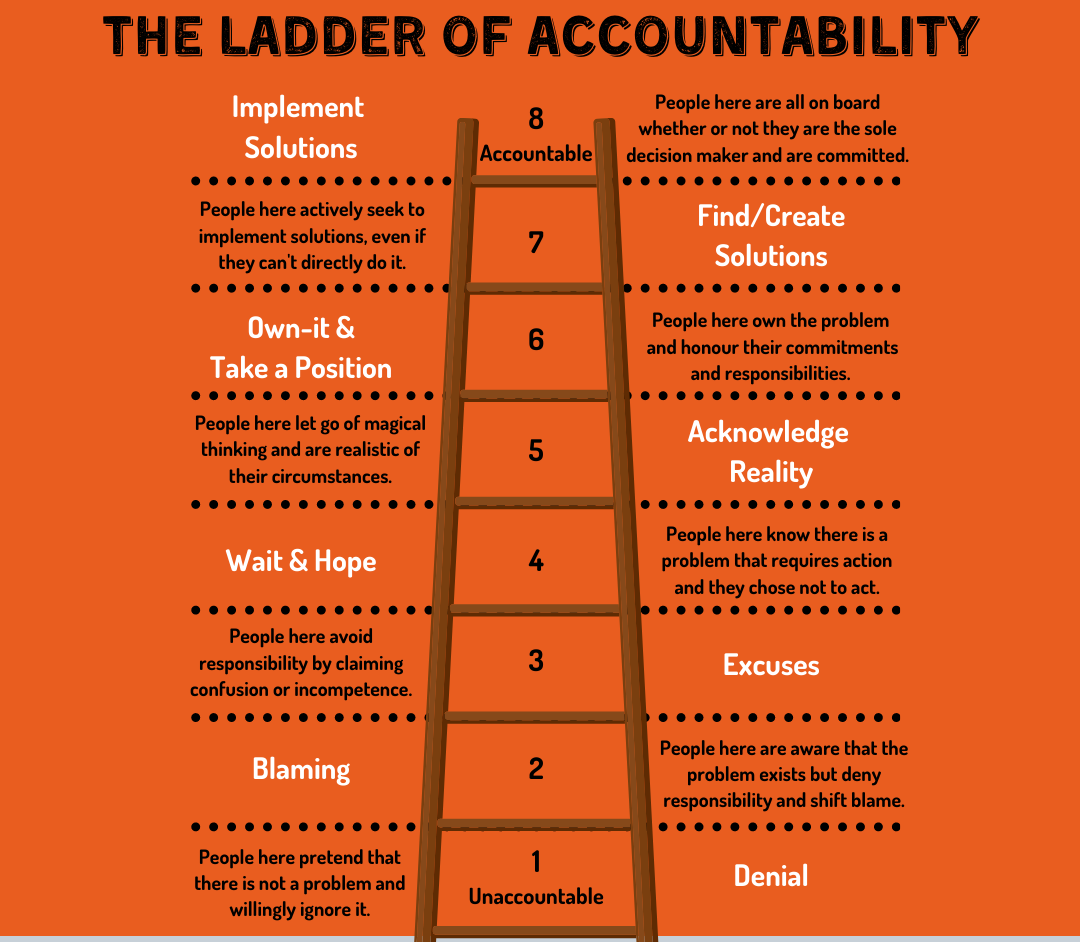
Moving up the ladder requires four things: humility, confidence, initiative, and a questioning attitude.
Humility. Humility is what keeps you from treating feedback like an attack. Leaders must be humble enough to acknowledge a problem when one arises. Furthermore, they must be willing to consider that they may have failed at some point, which caused the problem. My favorite Marine Corps leadership principle is “Know yourself and seek self-improvement.” This principle calls upon Marines to identify problems—whether within themselves or their teams—and ruthlessly seek possible solutions without pointing fingers. While humility is not one of our leadership traits, this principle is dripping with humility as a prerequisite.
Confidence. Owning a problem requires the confidence that it will not cost a leader their position. Aside from the egregious integrity issues, identifying a problem will always be seen as a sign of strength from a leader. This also implies a leader’s confidence in their own abilities and in their teammates. The failure is not a stain on their ability, but an opportunity to use their skill to get better. Good leaders don’t hide problems to protect themselves; they surface them early to protect the team.
Initiative. Identifying and owning a problem is only half the accountability battle. The other half is taking action to correct what is wrong. This trait dominates the top half of the ladder and is the only way to achieve full accountability over a situation. It is what builds creative solutions and drives a leader and their team to success. It should drive a leader crazy if a problem is identified, but action has yet to be taken. If there is something wrong, own it and fix it. Noticing the problem doesn’t count as progress—closing the gap does.
Questioning Attitude. Willful ignorance of an issue is how most leaders stay at the bottom of the ladder. This can either be ignorance of any problem or—and even more damning—their role within it. Questioning attitude, in this sense, isn’t just about seeking out flaws; it's about finding ways for a leader to more effectively lead the team. It’s the habit of asking, “What am I missing?” or “What did I set in motion that produced this result?” or “What creative action can I take to rectify this?”
The bottom half of the ladder is a victim mentality. Living here is accepting a reality where things happen to you.
The top half of the ladder is a leader mentality. Climbing the ladder forces you to face the reality that things happen because of you. Or at least that they keep happening because you allow them to.
But it all starts with extreme ownership from the leader. As my company commander in Iraq used to say, when something doesn’t live up to expectations, “I start by drawing concentric circles around MY desk.” If a process is found to be flawed or a result turns out differently than desired, the worst thing a leader can do is point the finger at others rather than at themselves. “It’s not my fault” might be true. But as a leader, it’s still your problem.
If you are taking the time to read this, you probably already understand the importance of accountability, and the ladder likely seems like common sense. The true challenge of leadership is instilling a culture of accountability within your team. Contrary to what many think, culture is what you permit, not what you preach.
Every member of a team can, and should, be a leader. Again, this starts at the top. What kind of example is set by the guy or gal at the top? Are they blaming others? Allowing others to blame each other or the situation? Ignoring problems? Accepting excuses? Because what you tolerate today becomes the standard tomorrow.
If you are reading this and thinking, “I have extreme ownership over accountability, but my team doesn’t,” then guess what? You don’t have ownership over accountability. It doesn’t matter if you are in a formal leadership role or not. You could be the team captain or a freshman. The CEO or analyst. General or Lieutenant. If the people around you are living on the bottom rungs, the leader has to stop asking, “Why won’t they?” and start asking, “What have I made easy for them to do?”